
Written by Josh Forman, Head of Science, Education & Outreach
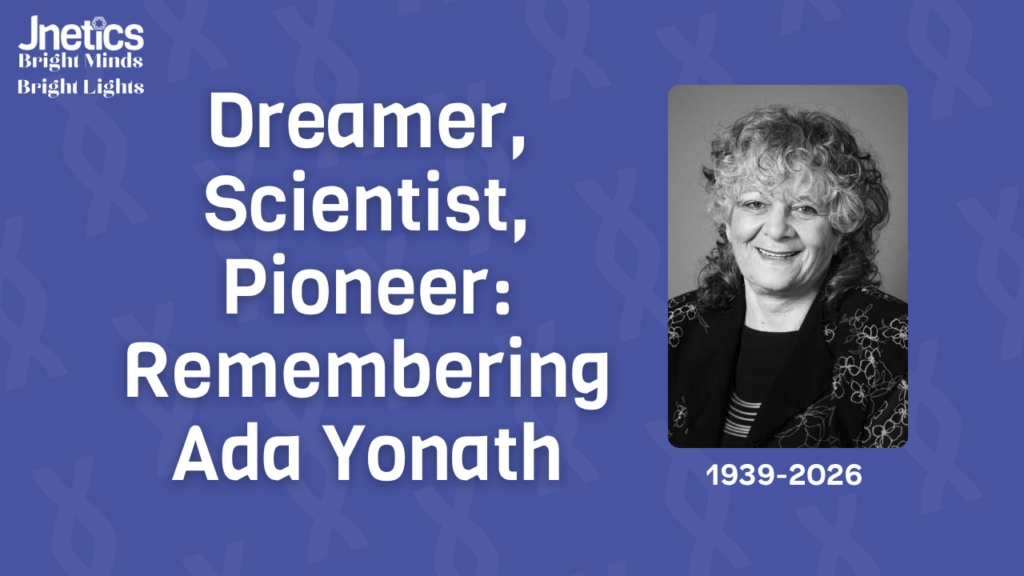
Professor Ada Yonath, one of Israel’s greatest scientists and a pioneer of structural biology, has died at the age of 87. Yonath won the 2009 Nobel Prize in Chemistry, the first Israeli woman to do so, for her work on the ribosome, the molecular machinery that translates our genetic instructions into proteins.
She has long been one of my favourite scientists. Her discoveries are part of that, but I have always felt a bit of shared history, as parts of my own family mirror hers. I also admire her persistence and the role she played in building scientific research in Israel.
Ada Yonath was born Ada Lifshitz in Jerusalem in 1939. Her parents had emigrated from Poland and ran a small grocery shop, but the family lived in considerable poverty.
Her father died when she was just 11, and the family moved to Tel Aviv. Money remained tight, and Yonath took on cleaning, babysitting and tutoring, including teaching mathematics in exchange for her school fees.
Despite these challenges, she developed an intense curiosity about the world. She studied chemistry and biochemistry at the Hebrew University of Jerusalem before completing her PhD in X-ray crystallography at the Weizmann Institute of Science. After postdoctoral research in the United States, she returned to Israel and established its first protein crystallography laboratory. For almost a decade, it remained the only one in the country.
She was helping to build Israeli science while the country’s scientific institutions were still young, bringing that same tenacity and can-do attitude to her work.
The most well-known part of Yonath’s work is the ribosome, one of my favourite topics when I studied biochemistry at university. Part of what intrigued me was that it is effectively a biological machine, universal across all living things. From bacteria to plants and animals, cells use ribosomes to translate genetic information into proteins. Nowadays, I often describe it as akin to a 3D printer, using instructions copied from DNA to create functional, 3D molecules that then perform their role.
I also found the ribosome’s RNA-based nature particularly fascinating. Although ribosomes contain both RNA (a molecule closely related to DNA) and proteins, RNA carries out the central catalytic reaction that joins amino acids together. This makes the ribosome a ribozyme: an RNA-based catalyst.
This provides a conceptual link to the earliest history of life, when RNA may have performed roles now divided between DNA and proteins, and could have been a precursor of DNA. Some viruses even have RNA rather than DNA genomes. For me, it brings up a biological version of the chicken or the egg conundrum.
Then there is the process itself. I always enjoyed visualising messenger RNA passing through the ribosome, transfer RNA bringing in the correct amino acids and a protein chain gradually emerging. Kind of like an old cinema projector, where the machine opens, the film fits in, and everything clicks back shut. Something incredibly complex can also feel beautifully mechanical.
Yonath’s work helped us visualise this process in three dimensions and understand how the ribosome’s structure allows it to work. For someone who had enjoyed learning about it so much, that was particularly exciting.
Getting there was an enormous challenge. To study ribosomes using X-ray crystallography, researchers had to persuade these large, flexible structures to form stable, ordered crystals. Many believed it could not be done.
Yonath later recalled: “I was described as a dreamer, a fantasist, even as the village idiot. I didn’t care.” What mattered to her was persuading people to let her continue the research. I particularly like that response. She was curious enough about the question to keep working, even when others thought she was wasting her time.
Her team investigated ribosomes from microorganisms living in extreme environments and developed methods to protect crystals from X-ray damage. Their first ribosome crystals were produced in 1980, but detailed structures required another two decades of work.
That persistence also helped medicine. Many antibiotics attach to bacterial ribosomes, stopping bacteria from making essential proteins. Yonath’s research helped explain these interactions and antibiotic resistance, providing a foundation for developing treatments. She shared the 2009 Nobel Prize with Thomas Steitz and Venkatraman Ramakrishnan.
Ada Yonath also has a connection to a school in which I previously worked, JCoSS, where one of the houses is named in her honour. A house name can become familiar without students knowing much about the person behind it. I hope those in Yonath house get to know her story. Her curiosity and determination are qualities I would want any student to see celebrated.
Being a good scientist takes imagination, patience and the willingness to keep trying when experiments fail. Yonath brought those qualities to her research and to building opportunities in Israel, continuing to lead a laboratory and collaborate until the final days of her life. For me, that is what makes her so inspiring. She wanted to understand something, believed it was worth investigating and worked at it for decades. I enjoyed learning about the ribosome at university; I have even more admiration for the persistence it took to show us how it works.
