
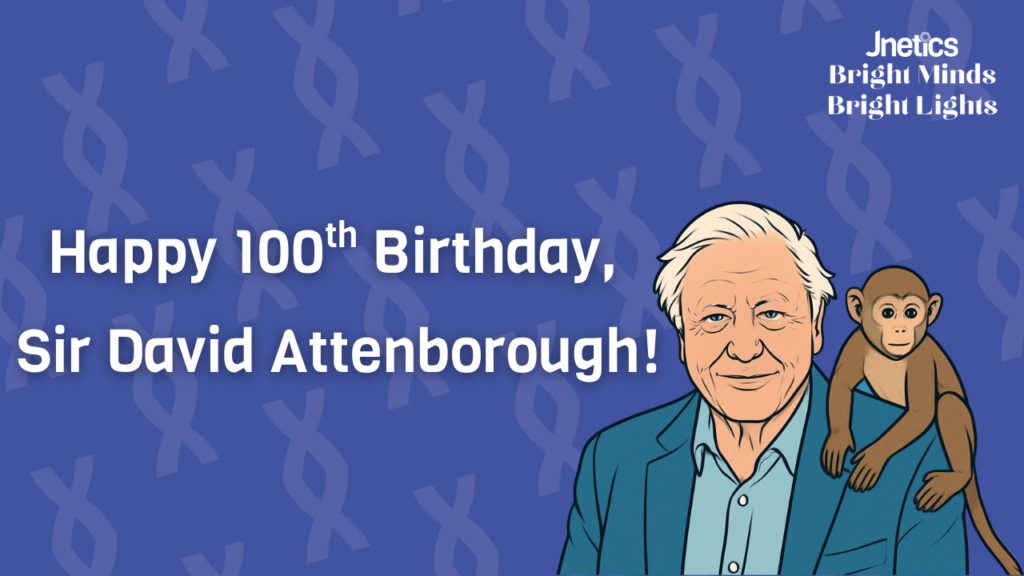
Written by Josh Forman, Head of Science, Education & Outreach
It’s hard to overstate what Sir David Attenborough has meant, not just to British society, but to how all of us see and understand the natural world. As he turns 100, it feels like a good moment to pause and reflect on that impact.
For me, as a biologist, that impact feels especially personal. Attenborough’s work opened up the natural world in a way that hadn’t really been done before. He didn’t just show people wildlife, he helped us understand it, and more importantly, care about it. What might once have felt like a niche corner of science became something that millions of people could connect with.
Of course, people have always loved animals. Trips to the zoo, favourite animals as children, those things have always been there. But somewhere along the way, that curiosity can fade. Anyone who’s spent time in a classroom will recognise that moment when topics like predator-prey relationships start to feel distant or uninteresting. Many biology teachers will recognise the familiar refrain, “Who cares about predator-prey cycles?”, perhaps even sympathising with it.
Attenborough changed that. He made those ideas feel real and relevant. He gave them meaning. That’s something I’ve tried to take into my own work, finding ways to connect knowledge with empathy, and to make people feel something about the science, not just understand it.
It’s worth considering that those values didn’t come from nowhere. During the Second World War, Attenborough’s family took in two Jewish refugee sisters, Irene and Helga, who had arrived in Britain on the Kindertransport. They were meant to stay only briefly but ended up living with the family for around 7 years, becoming, in his own words, “one family.”
Growing up alongside them clearly left a lasting impression. The experience exposed him, at a young age, to both the realities of human suffering and the importance of compassion and responsibility. It’s not difficult to see how that sense of empathy, of connection beyond our immediate world, runs through his later work.
What’s also striking is how his career came together. He clearly always had a passion for the natural world, studying natural sciences at Clare College, Cambridge before finding his way, somewhat unexpectedly, into the BBC. At the time, television itself was still finding its feet, and he joined what was then a brand-new area of factual broadcasting.
Famously, he wasn’t even meant to be on screen.
That changed with Zoo Quest in the 1950s, when he stepped in at the last minute to present. From there, things evolved quickly. Over time, through both his work behind the scenes and in front of the camera, he helped shape not just natural history programmes, but television more broadly.
For many of us, series like The Blue Planet were defining. They showed what happens when storytelling, science, and technology come together in the right way. The result wasn’t just informative, it was powerful.
That idea still shapes how we approach our own work. We use the best tools available to us, but technology on its own isn’t enough. It has to be paired with clear, thoughtful communication. It has to help people connect.
I don’t think many of us would claim we could ever match Attenborough’s ability as a communicator. But if we can help people care, even a little more, about the work we do, its value to both them and others and the world around them, that feels like a worthwhile goal.
And that’s something we’ll keep striving for.
Happy 100th birthday, Sir David Attenborough, and thank you for everything.
